
Income & Monetization
Diversify Beyond YouTube: Multiple Income Streams for Savvy Influencers
September 28, 2026
Unlock YouTube revenue for 2026! It's not magic, it's strategy. Get expert numbers, benchmarks, and a repeatable workflow to earn more and go full-time.

YouTube revenue 2026 won’t be driven by “one magic monetization method.” Instead, it will reward creators who build predictable view velocity, diversify income streams, and run a repeatable content creator workflow. If you’re planning how to transition from side hustle to full time, this guide gives you numbers, benchmarks, and steps you can execute immediately.
In 2026, most creator income will still come from a mix of ads, audience-funded features, brand deals, and direct sales (digital products, affiliate offers, and services). The key change: growth is increasingly tied to retention + session time (not just one viral spike), so your revenue becomes more stable when your content system is stable.
Here’s a realistic way to think about revenue sources. Exact earnings vary widely by niche, geography, and ad inventory, but the structure is consistent:
Ad revenue (RPM): For many channels, RPM can range roughly from a few dollars to $20+ depending on niche and viewer demographics. In higher-value niches (finance, B2B tech, software, insurance), RPM tends to be higher. In entertainment-heavy niches, RPM is often lower but can be offset with volume.
Affiliate revenue: Affiliate income can become a major lever once you have consistent views and match product intent to video topics. If you publish “how to” tutorials or product comparisons, affiliate can outperform ads per thousand views because you’re capturing purchase intent.
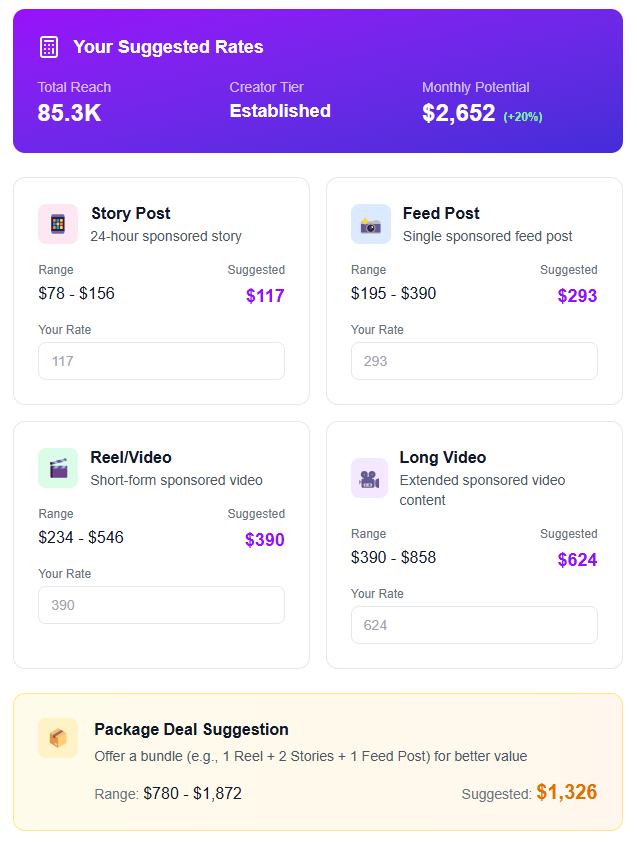
Brand sponsorships: In 2026, brands will increasingly prefer creators who can prove performance with data (retention, engagement rate, conversions) rather than only follower counts. A 50–200k view video can land a meaningful deal in the right niche if your audience quality is strong.
Memberships, Super Thanks, Super Chats: These work best for community-led channels—where you can deliver recurring value (live streams, behind-the-scenes, Q&A, exclusive templates). If your content is purely one-off entertainment, you’ll struggle to convert viewers into ongoing supporters.
To earn more in 2026, you don’t just need more uploads—you need improved video performance signals. YouTube’s recommendation system is strongly influenced by early engagement, watch time, and how viewers respond to your packaging. That’s why “how to get more views” has to be answered with both creative and distribution.
Start with a 14-day performance sprint. Choose one niche topic cluster (example: if you’re a fitness creator, pick “fat loss myths,” “meal planning templates,” “workout splits for busy people”). Publish 2 videos per week. For each video, do three things before you upload:
1) Nail the first 5 seconds: Your opening should communicate the outcome and reduce uncertainty (“In 60 seconds, I’ll show you the exact routine that helped me…”) rather than a vague intro. If you want a deeper framework, use The First 5 Seconds Is Everything — A Creator's Guide to Viral Hooks to generate options quickly.
2) Design retention scaffolding: Plan “micro-payoffs” every 10–20 seconds—examples, demos, quick results, or a compelling consequence. A common mistake is presenting all theory before showing the solution.
3) Match thumbnails to a single promise: Your thumbnail should reinforce the video title promise. If the promise is “Stop doing this plank mistake,” the thumbnail should show the mistake—then a “fix” moment later in the video.
Then measure outcomes with a simple rubric:
Early click-through rate (CTR) (or proxy through impressions and clicks), average view duration, and session impact (are viewers watching more videos after?). For creators asking about the YouTube algorithm 2026 changes, the practical takeaway is the same: packaging must earn the click, and structure must keep the viewer watching.
Finally, protect your output quality by batching. Many creators overshoot by trying to do everything daily. Instead, batch scripting and filming on one day, edit on two days, and schedule uploads using tools that support consistent publishing—your workflow matters as much as your ideas. If you need a schedule template, see Complete Guide to Building a Content Calendar for Consistent Views.
If you’re trying to make YouTube your full-time income, forecasting beats guessing. A practical income model helps you decide what to prioritize: ads, affiliate, sponsorships, or selling. The goal isn’t perfect math—it’s directionally correct planning so you can invest time where it pays.
Here’s a simple 2026 forecast method using a monthly projection:
Step 1: Estimate views per video and publish volume.
Example scenario: you publish 8 videos/month. In your niche, you average 40,000 views per video in the first 28–45 days after upload (and 10–20% continues to accrue). That’s roughly 320,000 views in month one.
Step 2: Apply RPM ranges for ads.
If your RPM is $4–$8 (varies by niche and geos), your ad revenue might land around:
320,000 views / 1,000 = 320 “thousand view units” → $4–$8 RPM → $1,280–$2,560/month.
Step 3: Add affiliate revenue with conversion logic.
Let’s say 0.6% of viewers who take an action click your affiliate link, and 2% of those clicks buy. Total buyers ≈ 320,000 × 0.006 × 0.02 = 38 buyers. If your commission is $15 average, affiliate ≈ $570/month. (Your numbers will differ, but the exercise makes the levers clear.)
Step 4: Add sponsorships as a separate line item.
If you can convert 1 sponsorship per month at $800–$2,500 (typical ranges vary massively), that might add $800–$2,500. Even when sponsorships are not guaranteed every month, you should track your “expected value” based on your pipeline activity.
Step 5: Add digital products or services (where possible).
Digital products—templates, courses, toolkits—can create higher margin and more predictable income. If you sell a $49 template and convert 0.2% of monthly views to purchases, buyers ≈ 320,000 × 0.002 = 640 sales. Even at conservative pricing and costs, this can beat ads over time—especially as your catalog grows.
This is why many creators focus on “sell digital products creator” strategies: you’re not only chasing views—you’re building an asset library that compounds. It also supports passive income for content creators because your catalog continues generating demand after you publish.
The safest path to YouTube revenue 2026 is diversification. Relying on ads alone is risky because RPM fluctuates with advertiser demand, seasonality, and content type. A diversified monetization stack makes your channel resilient.
Use this stack order (it works for most niches):
1) Ads to validate demand. If ads perform, you have audience attention. But don’t stop there—ads are typically the baseline.
2) Affiliate offers aligned to intent. Put affiliates where users are actively trying to solve a problem. Examples: “best tools for X,” “setup walkthrough,” “mistakes I fixed,” “compare A vs B.” Include a quick, honest disclosure and make the benefit specific.
3) Sponsorships with measurable deliverables. Instead of only “posting a video,” propose deliverables that reflect performance: usage rights, pinned comment, link-in-description cadence, and a recap follow-up video for higher session time. Brands want clarity, not mystery.
4) Digital products or memberships for compounding revenue. Digital products are especially powerful because your production pipeline gets easier after the first release. You can update and repackage offers based on what your audience comments and searches for.
Here’s a practical example: a productivity creator might publish “Notion dashboard for meal prep” tutorials (views + ads), run affiliate links for relevant templates and tools (affiliate revenue), pitch sponsors for time-management software (sponsorships), and sell a “Notion system starter kit” (digital product) that updates quarterly.
To make this real, build a content creator business plan that maps monetization to video types. For instance:
How-to videos → affiliate + product sales
Case studies → sponsorship + credibility
Community Q&A → memberships / Super Thanks
Series content → binge behavior and session impact
And if you’re currently stuck at low consistency, revisit How to Post with Consistency: A Creator's Framework. Consistency improves performance smoothing—which improves revenue planning.
Revenue in 2026 will reward creators who treat YouTube like a system: repeatable content + measurable performance + multiple income streams.
Building a strong YouTube revenue 2026 plan is easier when your workflow is centralized. With iBuildInfluence, you can go from ideas → scripts → scheduling → brand outreach without juggling five separate tools. For example, Trend Scout helps you spot topics before they peak, while Hook Lab generates and scores viral hook options for each video—so your packaging is consistently strong.
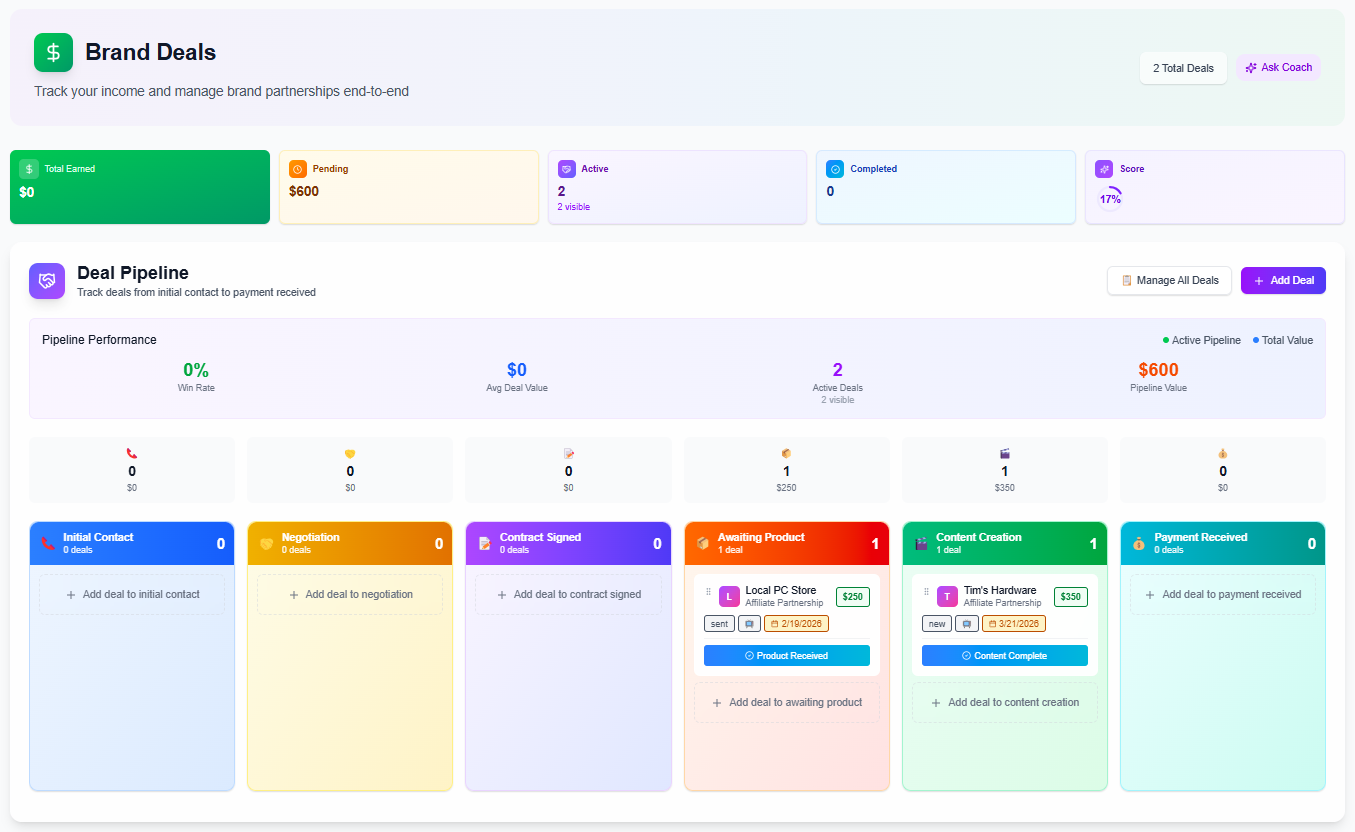
When it’s time to monetize, iBuildInfluence supports the creator side of revenue operations too. Use the Pitch Machine to draft brand pitches in seconds, then track deals in your pipeline with Deal Pipeline / Revenue Pipeline so you know what’s pending, what’s closed, and what needs follow-up. If you want smoother publishing (a requirement for better long-term view velocity), use Content Planner & Content Queue to plan weeks of content and auto-schedule—an underrated factor in “best software for YouTubers” conversations because consistency impacts performance.
It depends on niche, RPM, audience geography, and how diversified the channel is (ads, affiliate, sponsorships, and digital products). Many creators see ad revenue as a baseline, while higher incomes often come from sponsorships and product sales once they build consistent views and intent-driven content.
Focus on improving the full performance loop: stronger hooks (especially the first 5 seconds), higher retention through clear structure and micro-payoffs, and better packaging with thumbnails/titles that match a single promise. Track impressions, CTR, and average view duration, then run short sprints to double down on what works.
If your revenue model is consistent enough to cover expenses and you have a pipeline for deals and/or products, it’s a reasonable move. The best path is to forecast income monthly, diversify income streams, and build a content creator workflow you can sustain—so your output doesn’t collapse when pressure increases.
YouTube revenue 2026 will come from a mix of ads, affiliates, sponsorships, and direct sales—not one channel feature.
To learn how to get more views, optimize both packaging (hooks + thumbnails) and retention (structure + micro-payoffs).
Use a simple monthly forecast model (views → ad RPM → affiliates → sponsorships → digital products) to make decisions with confidence.
Diversify monetization to reduce RPM risk and increase compounding revenue over time.
Use iBuildInfluence tools like Hook Lab, Trend Scout, Pitch Machine, and Content Planner/Queue to keep your workflow consistent and monetizable.
Found this helpful? Share it:
iBuildInfluence Team
Creator growth strategist at iBuildInfluence. Helping content creators land brand deals, grow their audience, and build sustainable creator businesses.
Try iBuildInfluenceJump in and use Rate Calculator to price your next sponsored post.
Open Rate Calculator