Content Strategy
How Much to Charge for a Sponsored Post in 2026 (Rates)
October 4, 2026
Use plug-and-play brand deal pitch email templates, subject lines, and follow-up rules to boost replies—plus exact examples for creators.
Most creator outreach emails don’t get replies because they read like requests, not proposals. If you want brand deal pitch email templates that get replies, you need structure, specificity, and follow-up timing that respects how brand teams work. Below are battle-tested templates (with real examples) you can copy, personalize, and send to start earning sponsorships faster.
Brands receive hundreds of pitches every month. A reply-worthy email is easy to scan, clearly ties you to the brand’s goals, and answers the unspoken questions: Why you? Why now? What exactly will you deliver? In influencer outreach, speed matters too—many outreach teams triage within the first 10–60 seconds they spend on your message.
Here’s the formula you should build into every template: pattern interrupt (a tight reason you reached out), proof (one metric + one content example), specific offer (deliverables, timeline, and value), and low-friction next step (a question that makes it easy to respond). If you’re wondering how to transition from side hustle to full time, this is the part of the process that increases consistency—because replies lead to calls, and calls lead to revenue.
Use this template when you’re reaching out to brands for the first time. It’s designed to be readable on mobile and structured for a decision-maker who may only skim. Replace bracketed fields with your specifics, and keep the whole email under 120–160 words.
Subject line ideas (choose one):
1) “Partnership idea for [Brand]—[creator niche] content”
2) “[First name], quick question about a campaign for [Product/Theme]”
3) “Idea to help [Brand] reach [audience] with [content format]”
Email template:
Hi [Brand Team / Name],
I’m [Your Name], I create [niche] content for [audience type]. I’m reaching out because I noticed [specific campaign/product moment—real observation].
Based on my recent performance: [metric] on [platform] (example: “[post/video name]” got [number] views/likes/saves). My audience is especially responsive to [content angle relevant to brand].
If you’re open to it, I’d love to propose a [deliverable] campaign: [1–2 clear deliverables], published by [date/window].
Would you be the right person to discuss sponsorships for [campaign type], or is there someone else on your team I should contact?
Thanks!
[Your Name]
[Handle] | [Media kit link / stats snapshot]
Practical example: If you’re a fitness creator with 30k subscribers on YouTube, you might pitch a 30–45 second ad-read inside a “what I eat for [goal]” video. Your proof could be: “My last video on meal prep hit 18k views in 5 days with a 4.2% CTR from thumbnails.” That’s tangible, and it maps directly to sales intent.
If your account is growing but you haven’t gotten many replies, shift your pitch from “I want to work with you” to “Here’s how your brand wins.” This is especially effective for creators selling digital products, affiliate programs, or launching a repeatable series (e.g., weekly tips). Your goal is to show that you understand the brand’s marketing problem and you’re offering a measurable path to results.
Subject line ideas:
1) “Reducing CPA for [Brand] with [format] + [audience] targeting”
2) “Content series idea to drive [awareness/sales] for [Product]”
Email template:
Hi [Name],
I’m [Your Name], and I help [audience] learn/buy [relevant category] through [format]. I think [Brand] could benefit from a campaign that combines [your strength] with [their likely goal].
Here’s a concrete concept:
• Deliverable: [video/post/thread] featuring [specific product usage / story]
• CTA: [link-in-bio / specific URL / discount code / swipe-up style CTA]
• Timeline: publish by [date/window]
• Why it works: my audience responds to [why—hook style, topic cluster, or recurring series]
In my last [similar post], I saw [metric] and [supporting metric]. If that aligns, I can send a 1-page proposal with pricing and options (basic + premium).
Do you run sponsorships through a specific inbox or form?
Best,
[Your Name]
Real numbers that help: If you can, include at least one performance stat and one conversion indicator. For example, “I averaged a 6.1% engagement rate on Instagram Reels” or “Average CTR from thumbnails on YouTube is 7.3% across my last 10 videos.” If you don’t have conversion data yet, use behavioral signals like saves, shares, or comments that indicate purchase intent—brands care about downstream impact, not vanity views.
Some brands—especially larger ones—are skeptical because most outreach emails don’t include enough evidence. This template builds trust through a tight proof stack: one channel snapshot, one best-performing example, and one “what I’ll do for you” commitment. Keep the proof to 2–3 bullets so it doesn’t feel like a data dump.
Subject line ideas:
1) “Proof of performance: [campaign format] for [Brand]”
2) “Can I share a campaign example for [Brand]?”
Email template:
Hello [Name],
I’d love to partner with [Brand] on a [deliverable type] campaign for [audience/problem]. I’m reaching out because your brand messaging around [specific theme] matches my content style.
Quick performance proof:
• Reach/engagement: [metric] on [platform] (last 30/60 days)
• Example: “[post/video title]” → [number] views + [saves/shares/retention/CTR]%
• Audience fit: [brief description—age, interest, or geographic where relevant]
If we work together, I’ll deliver:
1) [Deliverable #1] with [specific hook/format]
2) [Deliverable #2] (optional) based on what performs best from your category
3) Reporting after publish: [what you track—views, engagement rate, click-through, code usage]
Would you prefer a short call next week, or should I send a proposal with 2 pricing tiers?
Thank you,
[Your Name]
[Media kit link]
Creator tip: If YouTube is part of your funnel, consider aligning your pitch to monetization and audience value. If you want a stronger angle, reference content packaging and consistency—because brands care whether your audience will actually watch and respond. (If you’re refining your monetization approach alongside pitching, this pairs well with Influencer Marketing for YouTubers: Partnerships & Sponsored Content That Converts.)
Follow-ups are where most creators fail. They either never follow up, or they follow up with a “just checking in” that provides zero new value. A good follow-up adds something: a better subject line, an updated example, or a simplified next step. Think of follow-ups as helpful nudges, not pressure.
Follow-up #1 (24–72 hours):
Subject: Re: Partnership idea for [Brand]
Hi [Name],
Quick bump—would you like a proposal for [deliverables] tailored to [campaign goal]? I can share a couple of content angles (e.g., [Angle A] and [Angle B]) so you can pick what fits best.
If you’re not the right contact, who handles creator partnerships for [Brand] campaigns?
Thanks,
[Your Name]
Follow-up #2 (5–7 days later):
Subject: Re: [Brand] sponsorship—content examples
Hi [Name],
As a reference, here’s one similar piece I recently published: “[title/link]” (it performed [metric]). If this style fits, I can put together a 1-page proposal with timeline and pricing.
Should I send it, or is another format (short-form vs long-form) a better match for your needs?
Best,
[Your Name]
Follow-up #3 (10–14 days later, optional):
Subject: Last follow-up: [Brand] + [your niche]
Hi [Name],
I’ll close the loop after this message. If sponsorships aren’t a priority right now, feel free to point me to the best contact for future campaigns. I’ll keep an eye out for when [Brand] is launching [product/campaign theme].
Appreciate your time,
[Your Name]
Timing matters: Many creators see improved response rates when they follow up within 48–72 hours for the first nudge. Also, if you receive no reply after 2–3 rounds, it’s typically not a “no forever”—it’s often “not now” or “wrong person.” Treat it like pipeline management, not rejection.
The best pitch emails don’t ask for attention—they earn it by making the brand’s decision easier in under 30 seconds.
Writing pitch emails is only half the job—consistent outreach and strong collateral are what move you from “sent emails” to “signed deals.” With iBuildInfluence, you can generate fast creator-ready messaging using Content Generator and turn one idea into a full package of hooks, captions, and scripts that make your pitch feel specific (not generic). Pair that with Hook Lab to score your hook angles so your campaign concepts are more likely to earn clicks and watch time—two things brands actually care about.
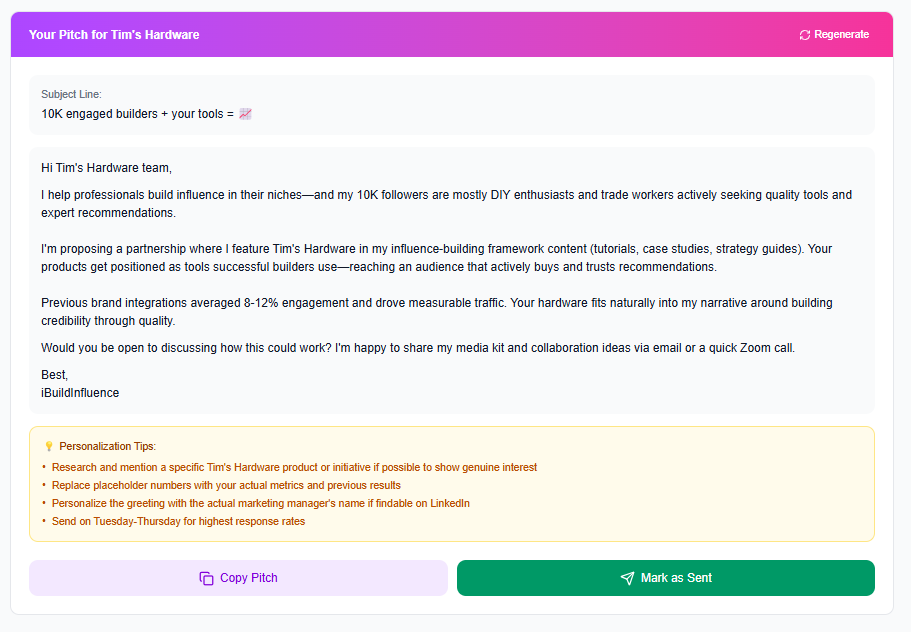
On the business side, iBuildInfluence supports your outreach process with Media Kit (auto-generated with live stats) and Pitch Machine to draft brand pitches in seconds. When a brand responds, the Revenue Pipeline / Deal Pipeline helps you track leads from pitch to payment so you don’t lose follow-ups in your inbox—an essential part of the content creator workflow if you’re working toward a stable full-time income.
Use a reply-worthy structure: personalize in the first line, show 1–2 relevant performance stats, propose clear deliverables, and end with a low-friction question. Keep it short enough to scan on mobile, and make the next step specific (proposal or call). Strong follow-ups usually double your chances of hearing back.
The best subject lines signal relevance and clarity. Examples include “Partnership idea for [Brand]—[niche] content” or “Quick question about a campaign for [product/theme].” Avoid vague lines like “Collaboration?” because they don’t help the recipient decide whether your email matches their needs.
Often, it’s better to share pricing only if the brand requests it or if you can provide a clear range with tiers (basic vs premium). If you don’t include pricing, offer to send a 1-page proposal with two options after they confirm fit. This reduces friction while still showing you’re professional and ready to move quickly.
Reply-worthy pitches are structured for fast scanning: personalization + proof + specific offer + easy next step.
Use templates designed for different brand mindsets: fast scan, value-first, and proof-driven.
Follow up with added value (new example, proposal offer, or clearer question), not “just checking in.”
Include realistic performance signals (engagement rate, saves/shares, CTR/watch-time/retention) even if you’re small.
Turn pitching into a system with iBuildInfluence tools like Pitch Machine and Deal Pipeline so you don’t drop leads.
Found this helpful? Share it:
iBuildInfluence Team
Creator growth strategist at iBuildInfluence. Helping content creators land brand deals, grow their audience, and build sustainable creator businesses.
Try iBuildInfluence