Content Strategy
How to Make a Media Kit in 2026 (Free Template Included)
October 1, 2026
Learn the top 5 TikTok hook formulas to stop the scroll fast—plus examples, rewrite steps, and a workflow you can repeat every post.
If your TikToks are getting views but not retention, your hook is probably leaking interest. On TikTok, the first 1–2 seconds decide whether people swipe—or stay long enough for the algorithm to test distribution. In this guide, you’ll learn the top 5 TikTok hook formulas you can reuse immediately, with examples and a step-by-step way to rewrite weak openings.
The “Promise + Proof” formula works because it answers two questions instantly: What’s in it for me? and Why should I believe you? TikTok viewers are skimming for value. If your opening promises a result and backs it up (with numbers, a quick demo, or a credible credential), you earn a longer watch time.
Formula: Promise (specific outcome) + Proof (metric, screenshot-style claim, or demonstration cue). Example structures: “Do X in Y time,” “Steal my template,” “I tested this so you don’t have to,” “This got me ___ views.”
Example hooks:
• “I turned 12 ideas into 30 videos—here’s the exact workflow.” (then show the planner screen immediately)
• “Use this hook and your comments will double (here’s what changed).” (show before/after on-screen)
• “Stop posting ‘update’ videos. This script gets saves—watch.” (flash the script, then show the result)
Practical steps: Write a promise that’s measurable or at least clearly defined. Then add proof in the first cut—don’t wait until the middle of the video. Even if you don’t have big numbers yet, you can use micro-proof: “I used this on my last 10 posts,” “It worked on a niche with 500 followers,” or “Here’s the exact checklist I followed.” This is especially important if you’re learning how to get more views without guessing.
This hook starts by naming a pain the viewer recognizes, then escalates it so they feel the cost of staying stuck. Finally, you relieve the tension by offering a solution—so the viewer thinks, “Oh wow, I need this.” The key is to avoid vague problems (“struggling to grow”) and instead use specific symptoms (“my retention drops after 2 seconds,” “my videos get likes but no followers”).
Formula: Problem (specific) + Agitation (why it’s hurting you) + Relief (what you’ll teach/fix now). Make it fast, emotional, and concrete.
Example hooks:
• “Your TikTok isn’t ‘bad’—your first line is. If people swipe in 1 second, do this.” (then immediately show your rewrite)
• “If your videos get views but no follows, it’s usually this one mistake.” (show analytics moment or a simple example)
• “Stop trying to be funny. If your hook isn’t clear, your audience never sticks around.”
Practical steps: Take one recurring comment you’ve received or one analytics pattern you’ve noticed. Then write: “If this is you, you’re probably doing ___, and it causes ___.” Follow it with “Here’s how to fix it in 20 seconds.” The relief should match what you actually deliver—no bait-and-switch.
Quick example rewrite: Weak hook: “Tips for TikTok growth.” Better: “If your videos reach 500 views then die, you’re probably using the wrong opening. Here are 3 hook lines to swap in today.”
Curiosity-gap hooks work when the viewer can sense there’s a missing piece they want—without feeling tricked. You’re not trying to confuse people; you’re highlighting a contrast: “You’re doing X, but the truth is Y.” Or you’re promising a reveal: “I’ll show you what nobody tells creators about ___.” The reveal can be delayed by a second or two, but it must happen quickly.
Formula: Curiosity trigger (a surprising or counterintuitive statement) + Reveal setup + Payoff moment (what they’ll see if they keep watching).
Example hooks:
• “The best TikTok hooks aren’t ‘catchy.’ They’re structured. Here’s the formula.”
• “I stopped writing long intros—and my retention went up. Want to see exactly what I changed?”
• “Nobody tells you this about TikTok scripts: the first sentence is doing two jobs…” (then show the two jobs)
Practical steps: Use one strong contrast or “myth vs reality” statement. Keep it simple enough that someone with zero context understands it. Then set a clear expectation for the reveal: “Here are 5 lines you can copy.” If you want to master the psychology behind viral moments, you’ll notice this strategy overlaps with why viral videos spread—because viewers feel a reward for continuing.
People love lists on TikTok because they’re easy to scan while scrolling. A numbered hook also creates a subtle commitment: “I might as well watch to see step 3.” This is one of the most practical formulas for consistent content, especially if you’re building a creator workflow for repeatable output.
Formula: “Do this in X” + numbered steps, or “3 things you must…” + fast preview. Keep your steps short and visual.
Example hooks:
• “3 TikTok hooks that stop the scroll—steal these today.” (show Hook 1 immediately)
• “If you’re a small creator, do these 4 things before posting again.”
• “I’ll give you a 15-second script to use for any niche (step 1 starts now).”
Practical steps: Choose a number you can deliver without rambling. For retention, structure your pacing: each “step” should start with a label on screen (“Step 1: …”) and a quick example. If you’re unsure what to cover, pull from your comments, DMs, and your own content performance. Use your best-performing topics as inputs for the next 7–14 days.
If you’re also trying to move beyond random posting into a real content creator business plan, list-based formats are ideal because they support batch creation and clear iteration. You’ll know what to test: step order, examples, and pacing.
Not every hook needs to be high drama. Often the most effective hooks are the ones that sound like a real message and match what your audience is scanning for. Direct address hooks reduce cognitive load: they tell the viewer you’re speaking to them specifically. Add on-screen text because many users watch with sound off.
Formula: Direct address + specific problem/result + on-screen text reinforcement. You can pair this with any of the other formulas (promise, curiosity, or numbers).
Example hooks:
• “Creators: if your CTR is low, do this.” (text: “Low CTR? Fix this.”)
• “Stop posting without a hook. Here’s your first line.” (text: “Use this hook:” then paste it)
• “Brand deals aren’t ‘random.’ It’s your pitch.” (text: “Fix your pitch in 30 seconds.”)
Practical steps: Write your first line as if you’re replying to a comment. Keep it under ~80 characters for readability. Then design your first 1–2 seconds to visually match the sentence. If your hook is “Here’s the template,” show the template instantly. This consistency between audio and visuals is what makes clarity feel powerful.
Mini checklist: Does the viewer understand the topic in one glance? Is the text large enough on a phone screen? Did you avoid jargon? If you want to turn one idea into multiple videos, combine direct-address hooks with a structured scripting approach—similar to turning one long output into multiple pieces, like in this guide on how to turn one YouTube video into 30 content pieces.
Great TikTok hooks don’t “perform”—they communicate value instantly and prove it fast enough that the viewer stays for the next second.
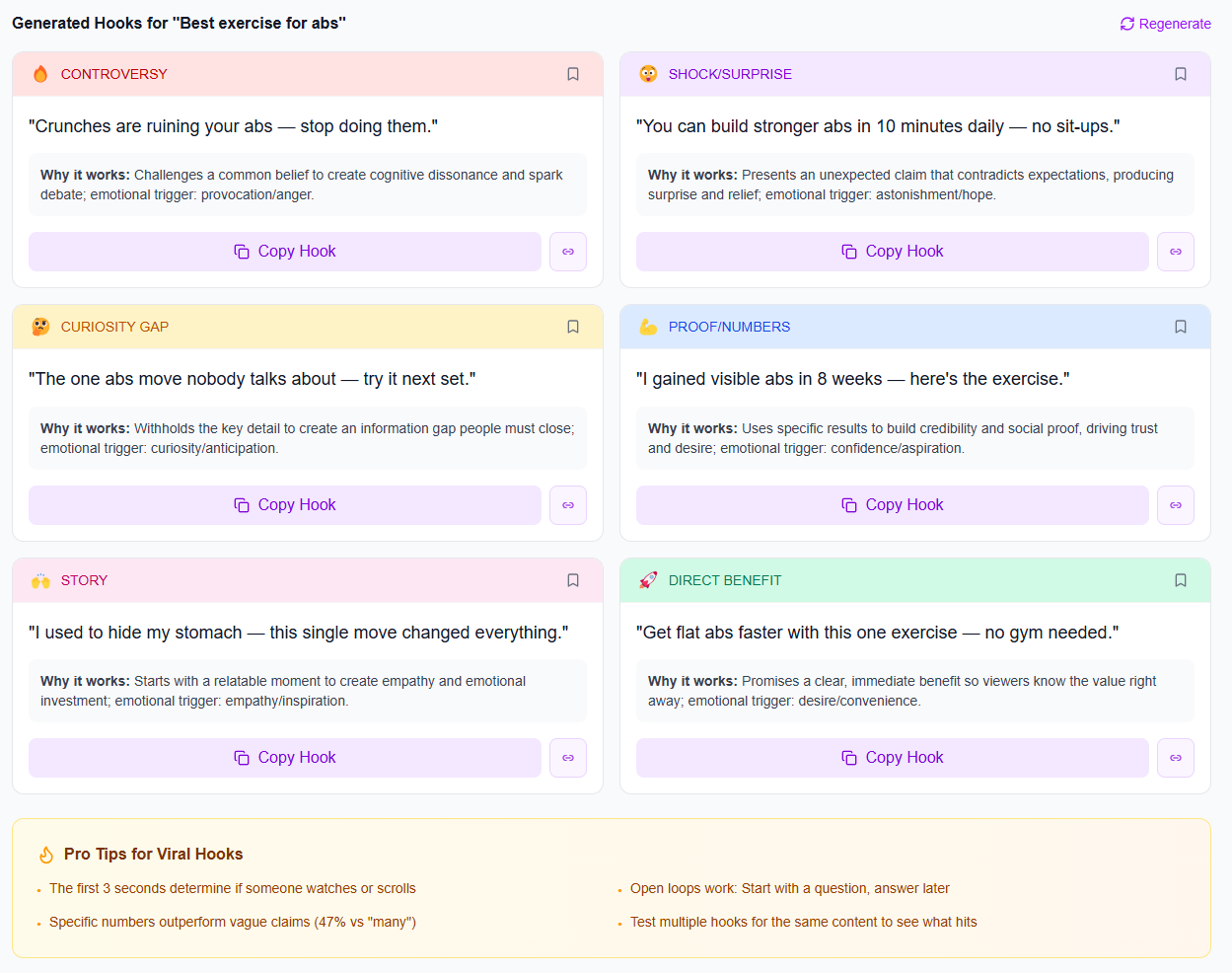
Hook writing is easier when you have a repeatable system instead of starting from scratch. With Hook Lab, you can generate and AI-score hook options for your topic—so you get 50 angles per subject and can pick the one most likely to earn retention. Then you can package that hook into a full script using Content Generator, turning one concept into a complete set of TikTok-ready lines (not just a single opener).
To improve hooks over time, you need feedback loops. Use Social Statistics to track engagement rate, reach, and performance signals across posts so you can see what formats actually hold attention. And if you’re serious about consistency, Content Planner & Content Queue helps you schedule a week of hook tests—so you can systematically validate which formula works for your niche, not just hope.
Start with the “Promise + Proof” and “Numbered Steps” formulas because they’re easy to understand and fast to produce. Beginner-friendly hooks also keep your topic specific, so viewers instantly know what they’ll get. Once you’re consistent, test “Problem Agitation + Relief” to build urgency.
Your hook needs to land in the first 1–2 seconds, but the content can be a short line followed by an immediate visual payoff. Say one clear thing: a specific outcome, a specific problem you’ll fix, or the exact type of value you’ll deliver. Avoid vague intros like “hey guys” or “today I’ll talk about…”
That pattern often means your hook is attracting the wrong audience or failing to match the content in the first seconds. Check whether the opening promise is delivered quickly and whether your on-screen text/visuals reinforce the message (especially for sound-off viewers). Use analytics to compare which hook style earns higher retention and replicate it in your content creator workflow.
Stop-the-scroll hooks usually do two jobs immediately: communicate value and establish quick credibility.
Use the Top 5 formulas—Promise + Proof, Problem Agitation + Relief, Curiosity Gap + Reveal, Numbered Lists, and Direct Address with on-screen text.
Write hooks that match your next 2 seconds of content—no bait-and-switch, no waiting until the middle.
Test hook angles systematically: change one element at a time (promise, proof, pacing, or visual) and track results.
Tools like Hook Lab and Content Generator help you generate, score, and expand hook ideas into repeatable TikTok scripts.
Found this helpful? Share it:
iBuildInfluence Team
Creator growth strategist at iBuildInfluence. Helping content creators land brand deals, grow their audience, and build sustainable creator businesses.
Try iBuildInfluence