Creator Tips
How to Plan a Week of YouTube Videos in One Sitting (Fast)
October 16, 2026
Learn how micro-influencers can create a professional, high-converting media kit that showcases engagement metrics, niche value, and secures brand deals.
Landing your first brand partnership as a micro-influencer has very little to do with having millions of followers and everything to do with how clearly you communicate your value. Brands today are actively shifting their budgets away from mega-celebrities and toward hyper-targeted creators who hold genuine sway over specific communities. However, if your pitch relies on a messy screenshot of your analytics or a generic PDF that looks like it was thrown together in five minutes, professional sponsors will scroll right past you.
The biggest mistake micro-influencers make when building their first media kit is treating it like an online resume or a digital scrapbook. A media kit is not a place to list your life story or paste every single brand you have ever casually mentioned in an Instagram story. Instead, it is a professional B2B sales document designed to answer one primary question for a brand marketing manager: What measurable return on investment will my company get by paying this creator? When you approach your creator business plan with this commercial mindset, every section of your portfolio changes.
To make this transition successful, you need to strip away the fluff and focus purely on conversion metrics, audience demographics, and content style. Brands do not care how much you love their products if your audience does not trust your recommendations. Your media kit must instantly establish authority within your niche—whether that is sustainable fashion, indie game development, or minimalist home organization. By framing yourself as a specialised media vendor rather than just an enthusiastic fan, you immediately command higher respect and better rates during negotiations.
Building this professional foundation also protects you from undercharging. Many creators struggle with imposter syndrome when quoting their first paid campaign, often accepting free products instead of cash. A data-driven media kit anchors your pricing in reality by highlighting your true engagement rate, audience geographic split, and historical campaign performance. When you can prove that your 8,000 followers engage at a staggering 6.5% rate—outperforming macro-influencers whose engagement hovers below 1%—you hold all the leverage you need to secure a profitable partnership.
For years, influencer marketing was dominated by vanity metrics where raw follower counts dictated budgets. Today, savvy sponsors look past follower totals because they know that an audience of one million unengaged spectators is worth far less than an active community of 5,000 hyper-loyal fans. As a micro-influencer, your superpower is your intimacy with your audience. Your media kit must weaponize this intimacy by putting your engagement rates front and center, backed by hard data from your analytics dashboards.
Start by breaking down your audience demographics with absolute clarity. Brands want to know who is buying what you recommend, so include verified geographic data, age ranges, and gender splits. If 68% of your followers are urban professionals aged 25 to 34 living in major metropolitan areas, state that explicitly. Furthermore, highlight your comment-to-view ratios and click-through rates on past affiliate or link-in-bio campaigns. Proof of past performance is the ultimate antidote to a brand's hesitation about working with smaller accounts.
Another powerful strategy is to include a brief audience psychographic breakdown. Describe not just who your followers are, but what problems they face and how your content solves them. If you run a channel focused on budget travel, explain that your audience actively seeks out hidden-gem itineraries and flight hacks. When a sponsor reads this and realizes your community matches their exact target buyer persona, your follower count becomes entirely secondary to your strategic alignment with their product.
Telling a brand that your content is high quality is meaningless; showing them is transformative. Your media kit should include a carefully curated portfolio of your absolute best-performing content, organized by format—such as short-form vertical videos, in-depth product reviews, or aesthetic carousel posts. Do not overwhelm sponsors with twenty different links; select three to four standout pieces that generated exceptional engagement or drove measurable sales for previous partners.
If you have worked with brands in the past, even on a gifted or uncompensated basis, turn those experiences into mini case studies. Include a single sentence summarizing the campaign's success, such as "Generated over 1,200 clicks and an 8% conversion rate for brand X's spring product drop." If you are brand new and have no formal sponsorships under your belt, treat your best organic posts as case studies. Highlight a video that went viral or sparked a massive comment section debate to prove your innate storytelling ability.
When selecting these examples, ensure they align with the types of campaigns you want to run in the future. If your goal is to land long-term ambassador contracts with outdoor apparel brands, do not feature your casual gaming reviews in prime real estate on your media kit. Tailor every visual asset to appeal directly to the specific vertical you are targeting, making it effortless for a marketing manager to visualize your face and voice representing their brand.
One of the fastest ways to stall a brand deal is to leave your pricing completely open-ended or force a marketing manager to chase you down for a rate card. A professional media kit should always include clear, transparent packages or base rates for your core deliverables. Whether you are selling a dedicated TikTok video, an Instagram Story sequence with a swipe-up link, or a bundled multi-platform package, clarity builds confidence.
Structure your offerings into distinct tiers or packages to cater to different marketing budgets. For instance, you might offer a "Starter Mention" package that includes a single dedicated Reel and usage rights, alongside a comprehensive "Growth Campaign" that bundles a YouTube integration, three TikToks, and whitelisting ad permissions. Offering structured packages encourages brands to spend more by showing them the added value of a bundled approach rather than haggling over a la carte pricing.
Be sure to explicitly outline your add-ons and terms within your pricing section as well. Clearly state your rates for exclusivity windows, whitelisting permissions (allowing the brand to run your content as paid ads), and rush turnaround times. By standardizing these variables ahead of time, you prevent scope creep, protect your time, and position yourself as a seasoned professional who runs a tight, organized creator business.
Your media kit is not just a digital resume for your content; it is a conversion tool that proves your unique community holds the exact attention a brand is desperate to buy.
Building a profitable creator business requires more than just great content; it demands professional systems that save you time and project authority. When you are ready to pitch sponsors, tools like the Media Kit builder automatically pull your live data—including cross-platform follower counts and engagement metrics—directly into a sleek, professional PDF overview that you can instantly share or export. This ensures your stats are always up to date without wasting hours updating manual spreadsheets.
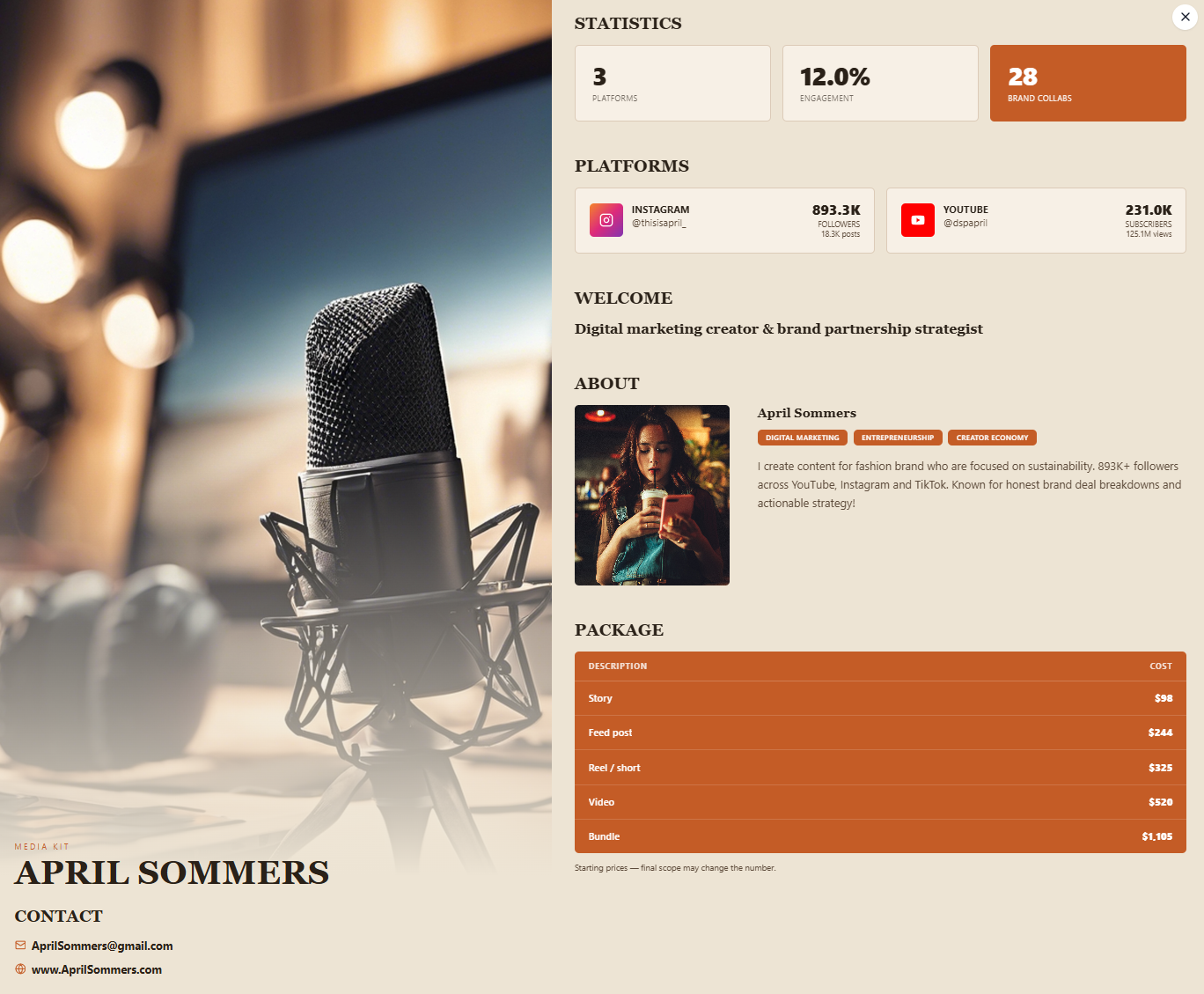
To turn those media kit views into signed agreements and paid invoices, you can seamlessly transition prospects into the Brand Deals revenue pipeline to track every stage of negotiation, while using the Rate Calculator to determine data-backed pricing tailored specifically to your niche and audience size. By combining real-time analytics with streamlined pipeline tracking, you remove the guesswork from monetization and focus entirely on growing your revenue.
A micro-influencer media kit should include an executive summary of your channel, verified audience demographics, engagement rate statistics, 3-4 top-performing content case studies, clear package pricing, and your direct contact information.
An influencer media kit should ideally be a single, highly polished page or PDF. Busy marketing managers review dozens of pitches daily, so keeping your core stats, portfolio links, and rates digestible within one clear view is essential for higher response rates.
Pricing should be based on engagement quality and niche value rather than follower count alone. Many micro-influencers charge anywhere from $100 to $500 per vertical video depending on their niche depth, production quality, and whether usage rights or whitelisting are included.
Treat your media kit as a B2B sales document rather than a personal scrapbook.
Highlight high engagement rates and niche demographics over raw follower counts.
Curate your top-performing content examples and turn them into mini case studies.
Include transparent, tiered pricing packages with clear add-ons for usage rights and exclusivity.
Automate your stats and streamline your pitch-to-payment workflow using professional creator platforms.
Found this helpful? Share it:
iBuildInfluence Team
Creator growth strategist at iBuildInfluence. Helping content creators land brand deals, grow their audience, and build sustainable creator businesses.
Try iBuildInfluenceJump in and use Media Kit to put the numbers a brand asks for on one page.
Open Media Kit