Creator Tips
What to Sell in a Influencer Store With Under 10K Subscribers
October 13, 2026
Learn how to write a brand deal pitch that actually gets replies in 2026. Get our free pitch template, discover proven outreach strategies, and land sponsors.

Landing lucrative brand deals in 2026 requires much more than just forwarding your subscriber count to a generic PR email address. Brands are flooded with hundreds of pitches every week, meaning that generic templates and unpersonalized copy go straight to the digital trash bin. If you want to build a sustainable content creator business plan, you need a targeted outbound strategy that focuses entirely on the value you bring to the sponsor's bottom line.
The biggest mistake creators make when writing a brand deal pitch is centering the entire message around themselves. Marketing managers do not care how many subscribers you have or how hard you worked on your last video; they care about audience alignment, conversion potential, and return on investment. When you frame your outreach around what the brand actually gains by partnering with you, your response rate instantly shifts upward. Instead of leading with metrics, lead with a tailored concept that proves you already understand their target demographic and product offering.
To pull this off effectively, you need to research the brand's current marketing gaps. Are they launching a new product line? Are they trying to reach a younger demographic on short-form video? Look at their recent campaigns and identify a specific angle where your unique content style can fill that gap. When you position yourself as a creative partner rather than just an ad space, you transition away from the transactional influencer mindset and establish yourself as an essential marketing asset for their business.
Furthermore, supporting your pitch with clear data makes it impossible for brands to ignore your commercial viability. If you are positioning yourself as a micro-influencer, lean heavily into your niche engagement rates rather than total reach. For strategic guidance on positioning your channel for monetization, exploring resources like iBuildInfluence to Hit Your Content Creator Goals (Plan + Execute) can help you align your analytics with what sponsors are actively looking to buy.
A winning pitch email follows a precise, disciplined structure that respects the recipient's limited time while instantly hooking their attention. It starts with a strong, curiosity-driven subject line that avoids looking like spam. In 2026, subject lines like "Content idea for [Brand Name] + past campaign results" or "Quick question regarding [Brand Name]'s TikTok strategy" perform significantly better than vague phrases like "Collaboration Inquiry" or "Sponsorship Proposal."
Your opening sentence should immediately establish who you are and why you are emailing them specifically. Drop a quick compliment about a recent campaign they ran to show you are not just blasting out copy-pasted templates. Then, move straight into the pitch: propose a concrete content concept that showcases their product in your signature style. For more inspiration on framing these initial emails, check out Brand Deal Pitch Email Templates That Get Replies (2026) to refine your wording and tone.
Finally, close with a low-friction call to action. Do not ask them to commit to a multi-post contract right out of the gate. Instead, ask a simple, binary question that makes it effortless for them to reply, such as "Would you be open to seeing a quick one-page concept brief for this?" This lowers the barrier to entry, opens the conversation naturally, and sets the stage for you to present your professional media kit later in the negotiation process.
Having a structured framework takes the guesswork out of cold outreach and prevents you from staring at a blank screen for hours. Below is a proven, battle-tested pitch template you can customize for your specific niche, audience size, and target brand:
Subject: Quick question about [Brand Name]'s Q3 creator strategy
Hi [Marketing Manager Name],
I’ve been following [Brand Name] for a while—especially loved your recent launch around [specific product/campaign].
I’m [Your Name], a creator focused on [your niche] where I help an engaged audience of [your target demographic] discover tools that simplify [pain point your content solves]. My community heavily aligns with your brand values, and our recent videos on [topic] averaged over [view count/engagement stat].
I have a content concept mapped out that I think would resonate powerfully with my audience while driving real conversions for [Brand Name]. It’s a short-form video series breaking down [specific content angle featuring their product].
Would you be open to seeing a brief outline of the concept?
Best,
[Your Name]
[Link to your portfolio or media kit]
One of the biggest reasons creators fail at securing brand partnerships is that they stop after sending a single email. Marketing managers are notoriously busy, and a lack of response rarely means a flat-out rejection; it usually just means your email got buried under fifty other priorities. Building a disciplined follow-up sequence is an absolute necessity if you want to scale your pitch volume and turn cold leads into paying sponsors.
Wait four to five business days before sending your first follow-up. Keep the follow-up thread short, polite, and additive—never send a passive-aggressive "just bumping this to the top of your inbox" message. Instead, add a quick piece of new value, such as a fresh data point, a newly published video that performed exceptionally well, or a minor tweak to your original pitch idea. This demonstrates persistence and professionalism without becoming a nuisance.
If you still do not hear back after two follow-ups, gracefully move on and log the brand in your CRM for the next quarter. Markets shift, marketing budgets open up, and a brand that says no today might eagerly reply to your pitch six months from now when their campaign goals change. Consistency in your outreach pipeline is what ultimately separates part-time hobbyists from full-time professional creators.
Your brand deal pitch is not a favor to the brand; it is a business proposal designed to solve their marketing problems using your creative leverage.
Executing an outbound pitching strategy requires a centralized command center to keep track of your outreach pipeline, rate calculations, and communications. The Pitch Machine acts as a powerful copywriting assistant designed specifically for cold outreach, helping you generate persuasive, customized pitch emails without staring at a blank screen.
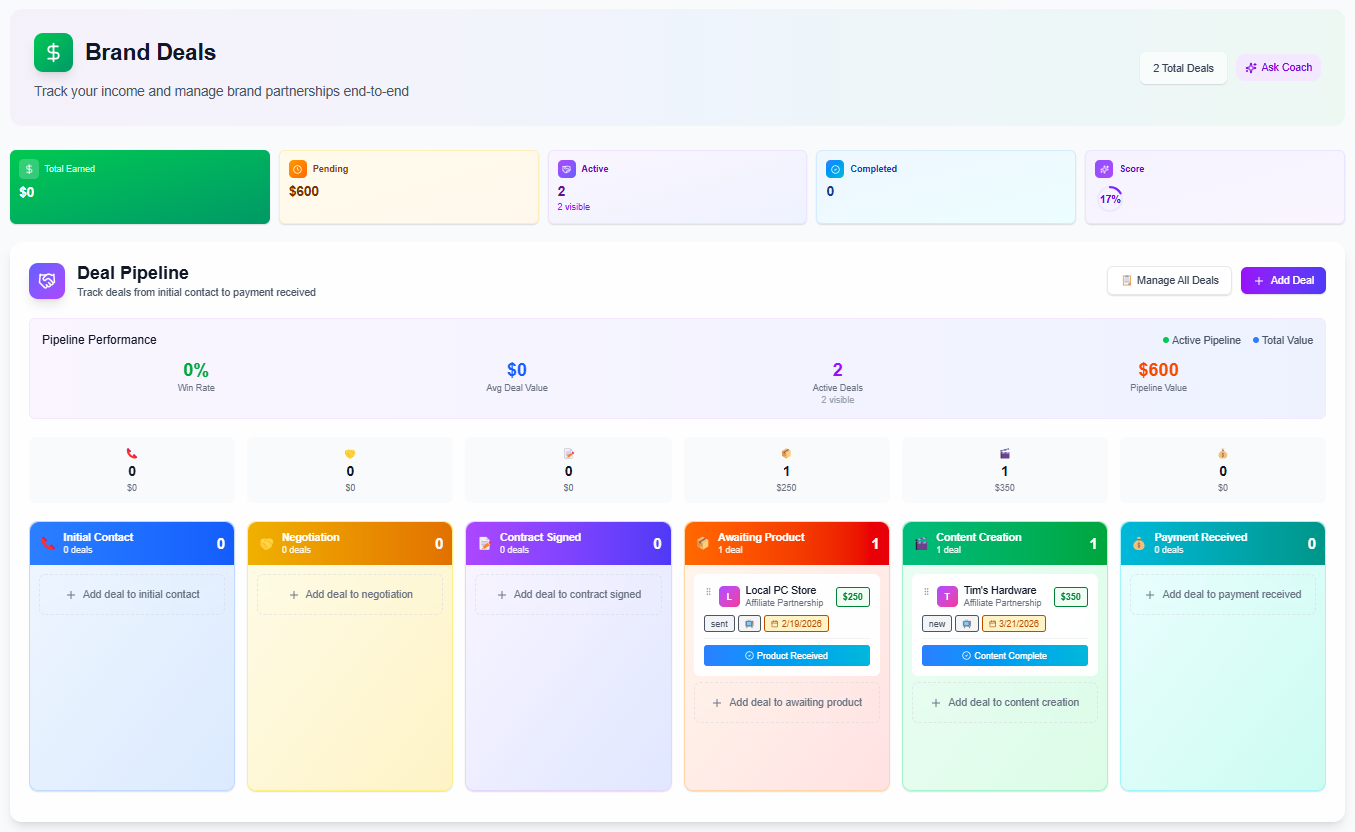
When brands express interest and ask about your rates, the Rate Calculator eliminates the guesswork and the fear of undercharging by analyzing your niche and audience size to generate data-backed pricing. Finally, you can manage the entire lifecycle of your incoming opportunities using the Brand Deals revenue pipeline, ensuring you never drop the ball on a warm lead.
Consistency is key when building a steady sponsorship income. Aim to send between 5 and 10 highly targeted, personalized pitch emails every week, treating outreach as a core operational task rather than an afterthought.
Not at all. Micro-influencers with smaller, highly engaged audiences often achieve significantly higher conversion rates than massive channels, making them extremely attractive partners for targeted brand campaigns.
You should generally avoid attaching heavy PDF files to your first cold email, as they can trigger spam filters. Instead, include a clean hyperlink to your live media kit or portfolio so the brand can view your stats instantly.
Shift your pitch focus from subscriber metrics to the specific ROI and value you deliver to the brand.
Use a compelling, curiosity-driven subject line that avoids looking like automated spam.
Keep your initial outreach short, specific, and focused on a single creative content concept.
Build a disciplined follow-up sequence to catch marketing managers when their schedules clear up.
Leverage tools like Pitch Machine and Rate Calculator to streamline your outreach and pricing strategy.
Found this helpful? Share it:
iBuildInfluence Team
Creator growth strategist at iBuildInfluence. Helping content creators land brand deals, grow their audience, and build sustainable creator businesses.
Try iBuildInfluence