Creator Tips
iBuildInfluence: Run Your Entire Creator Week in One Place
September 3, 2026
Stop burning out. Learn a Influencer grind system—workflows, tracking, and revenue steps—to transition from side hustle to full time.

The “creator grind” feels like you’re always behind: filming takes longer, ideas run out, and brand emails pile up. What if the hard part wasn’t creating—it was managing? In this guide, you’ll learn how to bring structure to your content creation, distribution, and income so you can move faster with less stress.
If your workflow depends on willpower, you’ll end up in a loop: late posts, inconsistent hooks, and missed opportunities to repurpose. A creator grind under control starts with a weekly system that turns your best work into repeatable output. Instead of asking, “What should I post today?” you ask, “What did we plan last week to publish this week?”
Here’s a practical example: let’s say you’re a YouTuber creating one main video per week. Use a simple content ratio—1 long-form asset → 6–12 short-form clips (depending on your niche). Then plan the short-form around specific moments inside the video: a hot take, a demo, a mistake to avoid, and a “you can do this today” takeaway. This reduces decision fatigue and helps you get consistent—even when creativity dips.
To make it real, schedule in batches. Most creators who stay consistent do it in predictable cycles: write + outline on one day, record on another, edit + cut clips in a focused session, then queue and schedule. This is also where a content creation tools 2026 approach matters: you don’t just “make content,” you manage a workflow that reliably ships it.
Creators often chase random advice: “Post more,” “Change your thumbnail style,” “Try a new niche.” Those changes might help, but they’re guesswork if you’re not looking at performance patterns. With creator management, you should treat analytics like a steering wheel—not a report you glance at once a month.
Start with a 30-minute weekly review using cross-platform analytics. Track: watch time and retention (for video), engagement rate, and shares/saves (for short-form). If you see high views but low watch time, your hook or early pacing needs work. If watch time is strong but CTR is low, your thumbnails/titles likely need testing.
Then connect analytics to action. For example, if your “how-to” videos get high shares but your “story” videos don’t, double down on formats that people save and send. Use Social Statistics to compare performance signals across platforms and identify what consistently moves the needle. If you’re asking “how to get more views,” data is how you avoid reinventing your content every week.
One more powerful move: record your weekly insights as decisions. Example decisions: “Keep the hook template that starts with a contrarian claim,” or “Cut intros under 8 seconds,” or “Make every video include one specific measurable step.” Over time, your content creator business plan becomes a set of tested rules—not vibes.
Many creators believe their job is to be more creative. But the fastest growth often comes from being more specific. Strong hooks and titles reduce friction: they promise value, clarify the outcome, and make the viewer feel like the video is worth their time. This is why two creators can upload similar topics and one wins—because they earned the click and the first 5 seconds.
A useful benchmark: if your videos are getting impressions but not clicks, you have a CTR problem. If clicks come but retention drops hard in the first 10–20 seconds, you have a hook/pace problem. Fixing the wrong layer wastes time.
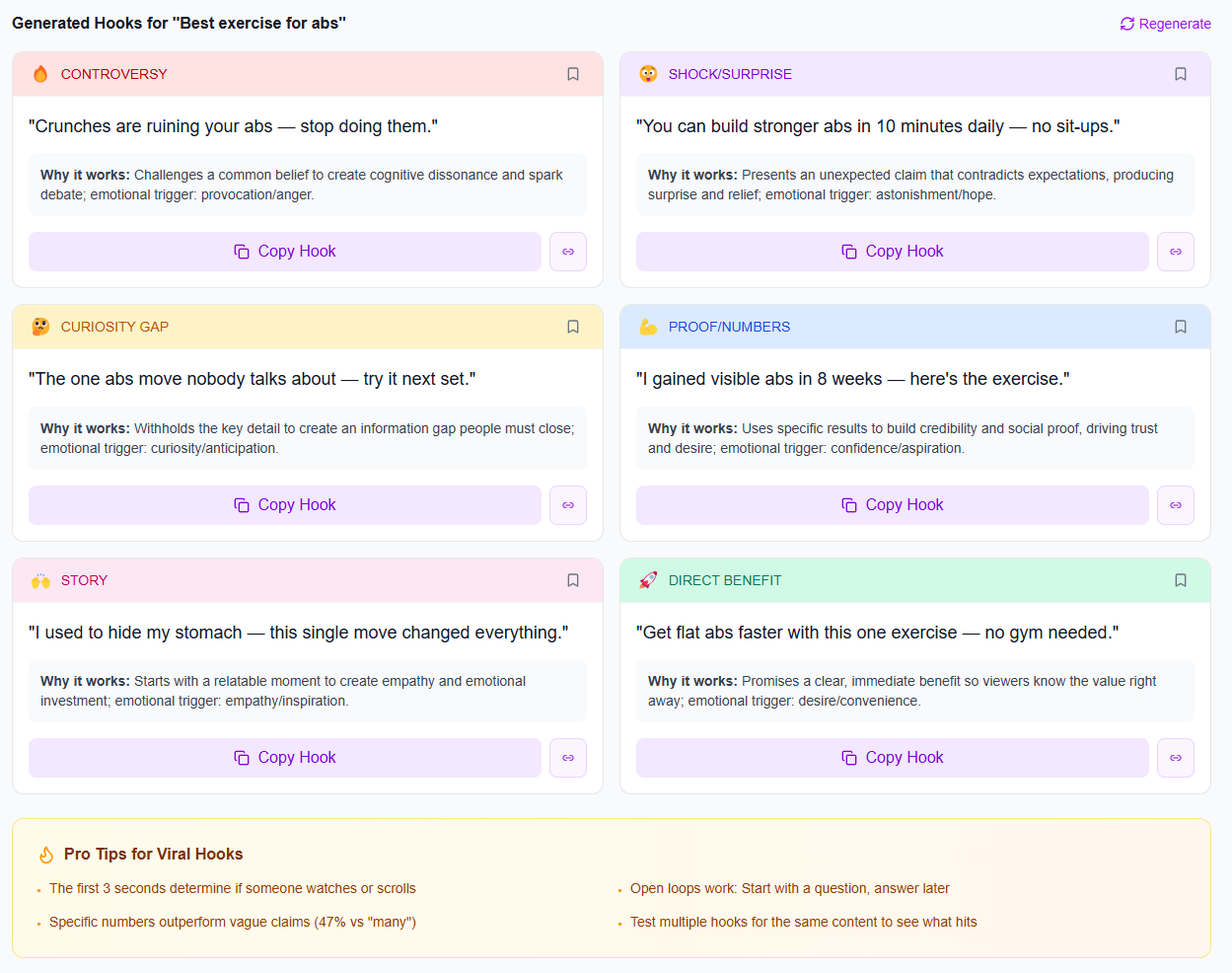
Build a testing pipeline for hooks. Write 10 variations for your next video using a structured approach: outcome hook (“Do X without Y”), mistake hook (“Stop doing this”), or timeline hook (“In 30 minutes…”). Then score them by clarity, curiosity, and specificity. This is exactly what Hook Lab is designed for—generate and compare hooks by topic and quickly pick which version is most likely to earn attention. After you publish, you’ll know whether your improvement was in the right place.
Also, align titles with your viewer psychology. For example, if your niche is “creator income,” avoid vague titles like “How to Make Money.” Use titles that signal a tangible result: “Build Passive Income for Content Creators With This Content-to-Sales Workflow.” That’s not just SEO—it’s expectation-setting. It improves retention because viewers arrive prepared.
Content isn’t a business until it reliably connects to money. That’s where the creator grind usually breaks: creators focus on output but postpone monetization until they “feel ready.” The truth is, readiness comes from systems. You need a repeatable path from interest → outreach → agreement → delivery → payment.
Think in stages and keep a CRM-style record. When a brand inquiry comes in, log it with date, channel, deliverables, and status. When you send a pitch, track follow-ups. When a contract is signed, move it forward. When payment is received, mark it closed. This turns chaos into a pipeline where you can forecast.
Here’s a realistic workflow: you set a weekly outreach target—say 10 relevant pitches per week. Use a rate calculator so your offers reflect your actual market position, not fear or guesswork. Create pitches with an AI-assisted tool like Pitch Machine so you can personalize quickly without rewriting everything from scratch. Then store opportunities in a Deal Pipeline / Revenue Pipeline so you can see which brands are stuck and why.
For additional protection, use Contracts & Invoices. Payment delays are a common creator stress point, and a structured invoice + contract flow reduces friction. If you’re working on how to transition from side hustle to full time, this is one of the clearest ways to stabilize income: you stop relying on “sometimes I get a deal” and start running a measurable process.
Want a smarter monetization mix? If you do YouTube, start by optimizing how you earn per view (ads, sponsorships, affiliates, and digital products). You may also want to read From Views to Income: Optimize Your YouTube Monetization Strategy to see how creators combine revenue sources.
The fastest way out of the creator grind isn’t working harder—it’s creating fewer decisions per week and more feedback loops per upload.
iBuildInfluence is built for creators who want structure, not generic “B2B” dashboards. For staying consistent, Content Planner & Content Queue help you map weeks of content and auto-schedule so your output doesn’t depend on daily motivation. When it’s time to produce, Content Generator can turn one idea into a full content package—scripts, captions, and post assets—so you spend less time starting from scratch.

To keep your creator grind under control with data and outreach, use Social Statistics to track what’s performing and where to adjust. For monetization, Pitch Machine accelerates brand outreach, while Deal Pipeline / Revenue Pipeline keeps every opportunity organized from pitch to payment. This combination helps you connect “what you post” to “what you earn,” which is the missing piece for most creators trying to grow.
Focus on building income reliability first: track outreach, proposals, deliverables, and payment in a simple pipeline. Run weekly outreach targets and test offers using a rate calculator so you’re selling with confidence, not guessing. Consistency in both content and monetization is what makes full-time realistic.
Use tools that cover planning, production, and distribution together—rather than scattered apps. A strong stack typically includes content planning/scheduling, analytics, hook/title testing, and outreach or deal tracking. That’s why iBuildInfluence groups these workflows across multiple creator growth pillars.
Stop changing everything at once. Start by fixing the layer that matches your metrics: CTR for clicks, retention for watch time, and shares/saves for audience value. Batch your workflow and plan weekly so your effort goes into iteration, not constant restarting.
Replace daily decision-making with a weekly content system and batch workflow.
Use cross-platform analytics to target the real bottleneck (CTR, retention, or shareability).
Test hooks and titles systematically to earn attention in the first seconds.
Turn content into income using a simple, trackable revenue pipeline from pitch to payment.
Use iBuildInfluence to connect planning, performance, and monetization so the creator grind stays under control.
Found this helpful? Share it:
iBuildInfluence Team
Creator growth strategist at iBuildInfluence. Helping content creators land brand deals, grow their audience, and build sustainable creator businesses.
More from iBuildInfluenceJoin thousands of creators using iBuildInfluence to land brand deals, grow their audience, and build real income.
Start Free