Creator Tips
How to Build a YouTube Content Strategy That Attracts Brand Deals in 2026
October 30, 2026
Learn how to calculate your YouTube sponsorship rates in 2026. Use proven pricing formulas, charge for usage rights, and stop leaving money on the table.

YouTube sponsorship rates in 2026 are determined by your median organic views, deliverable complexity, and the commercial rights you grant to the buyer. This pricing framework is designed for growing video creators who want a clear, repeatable system to quote sponsors without underpricing their work or guessing what an agency expects to pay.
Never quote a sponsorship rate based on your lifetime subscriber count or your best-performing viral video. Brands pay for predicted reach, and subscriber counts do not tell a media buyer how many impressions your next video will generate. Open your analytics and look at your last ten long-form uploads, deliberately removing your single highest and single lowest outliers. Take the remaining eight videos, add their 30-day view counts together, and divide by eight to determine your median baseline view count. This number represents the realistic audience size you are selling to a prospective partner.
Once you have your baseline view count, apply a baseline Cost Per Mille (CPM), which is the cost per one thousand views. For standard lifestyle or entertainment niches, baseline CPMs often begin in the range of 20 to 30 dollars as a worked example, while specialized topics like developer tooling, business software, or personal finance routinely command baseline figures between 50 and 90 dollars. The foundational formula is straightforward: (Baseline Views / 1,000) * Target CPM = Base Placement Fee. If your median baseline is 15,000 views and your agreed baseline rate is 30 dollars CPM, your standard integration base starts at 450 dollars. If you want to see how this compares across other platforms, review our guide on how much to charge for a sponsored post in 2026.
A standard 60-second integrated shoutout requires a different pricing tier than a fully dedicated video or a brief product mention. An integrated segment sits inside your regular content editorial flow, which preserves retention while serving the sponsor. A dedicated video, by contrast, hands over your entire topic, title, and runtime to a single company. Dedicated videos carry higher viewer drop-off risks and can depress organic click-through rates. For that reason, dedicated videos should carry a multiplier of at least 2.5x to 3x your standard integration rate to account for production overhead and channel velocity risk.
When structuring shorter integrations, clarify the exact placement within the video timeline before locking in your price. Mid-roll integrations placed right after your organic hook typically generate higher watch time for the brand than end-screen mentions, which viewers often skip. For creators monetizing through ad placements alongside brand deals, always check YouTube Help for the current rule on mid-roll ad placement parameters, as YouTube periodically updates runtime requirements. Use this simple multiplier rule: treat a 60-second mid-roll as 1.0x of your base fee, price an end-card mention at 0.5x, and price a fully dedicated video at 2.5x to 3.0x.
Exclusivity prevents you from taking money from competing brands, which means it carries an immediate commercial cost. When a sponsor asks for category exclusivity, they are asking you to turn away paying clients in their industry for a specific window of time. If you do not charge an additional fee for this clause, you are paying for their exclusivity out of your own revenue potential. Never allow an agency to slip broad exclusivity language into a standard deal agreement without a line-item adjustment.
Price exclusivity as a direct percentage surcharge added to your total placement fee based on both duration and scope. A standard 30-day lockout window within a narrow product category—such as web hosting providers or mechanical keyboards—should add between 20 percent and 30 percent to your placement fee. If a sponsor demands a 90-day window across an entire broad category like consumer electronics, the surcharge should be 50 percent to 100 percent. As a worked example: if your base integration rate is 1,000 dollars and a brand requests a 30-day competitor lockout at a 30 percent surcharge, your adjusted total becomes 1,300 dollars. If they cannot pay the premium, remove the exclusivity clause entirely.
Your base fee only covers organic publishing to your existing subscriber feed. If a brand wants to take your video cutdown, your voiceover, or your face and run it as a paid advertisement on YouTube, Meta, or TikTok, that is advertising licensing, not organic sponsorship. Granting perpetual, unmonetized usage rights gives a brand the ability to run ads against your likeness forever without paying you an additional dollar. Every contract must state that the initial placement fee includes only standard organic distribution on your owned channel.
When a sponsor requests paid ad usage rights, charge a monthly licensing fee based on a percentage of your original base creation fee. A standard industry baseline is charging 30 percent to 50 percent of the initial video production fee for every 30 days of digital paid ad rights. For instance, if you produced a video integration for 2,000 dollars and the brand wants 60 days of digital ad rights to run paid campaigns, add a 40 percent monthly licensing fee. That adds 800 dollars per month, bringing the two-month usage fee to 1,600 dollars, making the total package worth 3,600 dollars. Once you agree on terms, make sure your email communication is concise by adapting brand deal pitch email templates that get replies.
Sending a sponsor a single flat dollar figure invites unnecessary haggling and gives them a simple binary choice to say yes or no. Instead of quoting one number, structure every brand response into three distinct packages: Good, Better, and Best. This approach shifts the conversation from whether they want to work with you to how deeply they want to partner. It also frames your higher-priced services against an accessible entry tier, giving the media buyer budget flexibility while preserving your hourly margins.
Your first tier should be your baseline deliverable, such as a 60-second integrated mention with an organic link in the video description. Your second tier should add high-conversion distribution assets, such as a pinned comment, a YouTube Community tab post, and a dedicated cutdown for YouTube Shorts. Your third tier should bundle full campaign value, combining the long-form integration, a Shorts adaptation, a pinned comment, and 30 days of paid usage rights. Presenting structured options anchors your value, demonstrates professional media handling, and frequently encourages agencies to select the middle tier rather than squeezing down your base rate.
Never price your channel solely on subscriber count; price the guaranteed labor, the expected median reach, and the commercial rights the brand wants to exploit.
Managing brand rates, contract deliverables, and outreach pipelines manually often leads to unbilled usage rights and underpriced integrations. Within iBuildInfluence, you can manage this entire operational workflow in one centralized dashboard. Use the Rate Calculator to determine data-backed rate cards across long-form integrations and Shorts using your real channel stats, eliminating the guesswork from every pricing conversation.
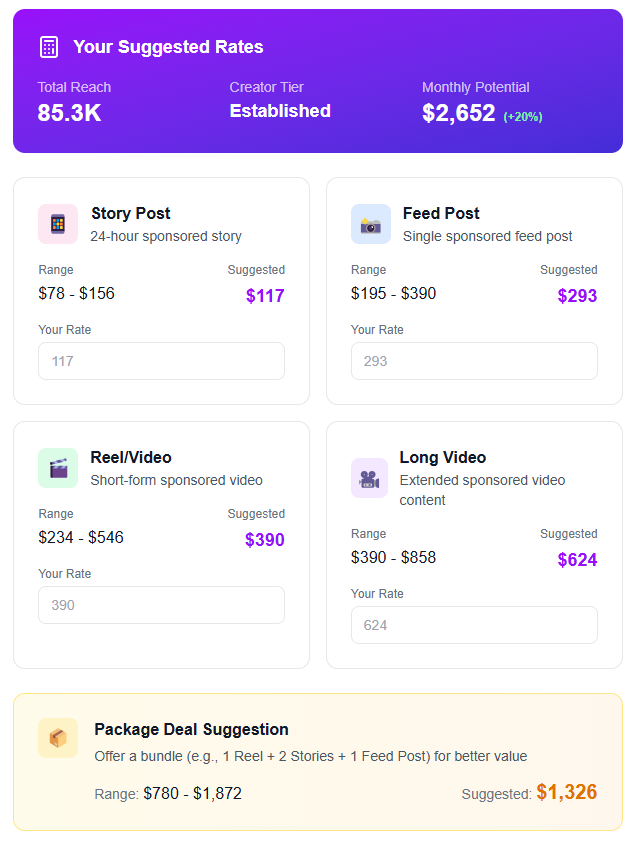
When an inquiry progresses, open the Proposal Builder to structure tiered packages with itemized upsells for exclusivity and paid usage so brands see your value clearly. Finally, log signed agreements directly into Contracts to track deliverable deadlines, review expiration dates on usage rights, and prevent scope creep from hurting your margins.
Always base your pricing on median views rather than total subscribers. Subscribers indicate historical channel activity, but brands buy the attention your upcoming video will actually capture. Calculate the median 30-day view count of your last eight regular uploads to determine your true baseline reach.
Politely inform the brand that your quoted rate covers organic posting to your channel only. Explain that commercial ad usage, whitelisting, and paid amplification require a separate licensing agreement. Offer to include a 30-day or 60-day usage extension as an itemized add-on at a percentage of the base production fee.
Recalculate your median view baseline every quarter or whenever your 30-day rolling view average increases by at least twenty percent. Update your base rate accordingly while keeping your production time and niche value in mind. If you see high demand and your pipeline fills up consistently, raise your CPM to reflect your limited inventory.
Calculate your baseline using the median view count of your last eight regular uploads, excluding viral and extreme low outliers.
Separate organic channel posting fees from commercial licensing, and charge a monthly percentage fee for any paid ad usage rights.
Add a 20 percent to 50 percent surcharge whenever a sponsor requests category exclusivity to compensate for lost partnership opportunities.
Deliver proposals with three structured tiers rather than a single flat fee to protect your baseline rates and upsell additional assets.
Found this helpful? Share it:
iBuildInfluence Team
Creator growth strategist at iBuildInfluence. Helping content creators land brand deals, grow their audience, and build sustainable creator businesses.
Try iBuildInfluence