Income & Monetization
YouTube RPM in 2026: How Much YouTube Pays Per 1,000 Views by Niche
October 24, 2026
There is no fixed subscriber number for $1,000/month on YouTube in 2026. Use views, RPM, deals, and products to build a real plan.
There is no fixed subscriber count that guarantees $1,000 a month on YouTube in 2026. Income comes from views, niche value, brand deals, and products—not a magic sub total. This guide is for creators who want a clear formula they can run with their own analytics instead of chasing someone else’s number.
Subscribers are a reach signal. They are not a revenue line. Two channels with the same sub count can earn very different money because watch time, niche CPM potential, audience buying power, and extra income streams rarely match. A cooking channel with loyal buyers can out-earn a larger entertainment channel that gets cheap ads and no sponsors.
Before you ask “how many subscribers,” ask “what does one thousand dollars require from my mix?” Check YouTube Help for current Partner Program rules, Shorts monetization details, and mid-roll eligibility—those thresholds change, and stating an old number as fact will mislead you. Your real inputs are monthly views, revenue per thousand views from your dashboard, and what you can sell outside ads.
Open YouTube Analytics and pull last month’s figures. You need estimated revenue (or RPM if YouTube shows it for your account), total views in that period, and average view duration so you know whether growth is shallow or sticky. A simple working formula is: target monthly ad income ÷ your recent revenue per view = views you need from ads alone. Revenue per view is total ad revenue divided by total views for that same window. Treat this as a worksheet, not a universal rate.
Example only: if your channel earned $200 from 40,000 views last month, revenue per view is $0.005. Hitting $1,000 from ads alone would need about 200,000 views at that same rate. Your number will differ by niche, geography, season, and the YouTube algorithm in 2026 favoring retention on your topics. Improve titles, hooks, and packaging first if you want how to get more views without posting more noise. Ads alone are the slowest path for many small channels, which is why the next layers matter.
One sponsored video or package can cover a large share of a $1,000 month. That is why subscriber count stops being the whole story once brands care about your niche fit and engagement. Price from value delivered—audience match, deliverables, usage rights—not from a random sub milestone. When a brand asks for rates, build the quote from your formats (integration, Short, post) and extras, then negotiate.
A practical decision: decide what share of $1,000 should come from sponsors versus ads. Example only: if you aim for one $600 deal and $400 from ads, your ad view target drops sharply compared with ads-only math. Track pipeline stages so warm leads do not die in the inbox. For rate framing and packaging language that brands take seriously, use a clear rate card approach like the one in how much to charge for a sponsored post in 2026, then adjust for exclusivity or rush work.
If you want passive income for content creators, stop relying on a single ad check. A focused offer—preset pack, template, mini-guide, or members tier—can move you toward $1,000 with a smaller audience that trusts you. The decision is to sell digital products creator-style: one narrow product your viewers already ask about, priced so a realistic number of buyers covers the gap ads do not fill.
Example only: 40 sales of a $25 digital download is $1,000 before fees; 100 members at $10 is the same monthly shape with more stability. You do not need viral scale if the offer matches a painful problem in your niche. Pair the product with a simple content creator workflow: mention it on camera, put the link where buyers already look, and fulfill fast. For a fuller map of shop, fan clubs, and sponsors together, read how small YouTubers get paid in 2026 and fold the pieces that fit your channel.
Write a one-page content creator business plan with three income columns: ads, brand deals, and owned products or memberships. Assign a monthly dollar target to each so the sum is at least $1,000. Then reverse each column into actions: videos needed for ad views, pitches sent per week, and product mentions or launch tasks. This is also the frame for how to transition from side hustle to full time—you prove the mix works before you quit other income.
Protect consistency with a content creator workflow you can keep: batch scripts, shoot in blocks, schedule uploads, and review analytics weekly—not hourly. Tools to manage content schedule only help if they show go-live dates next to deal and invoice dates. Focus on retention and packaging so the YouTube algorithm 2026 has a reason to keep recommending you. Subscriber growth becomes a side effect of that plan, not the goal that replaces revenue design.
You do not need a magic subscriber number for $1,000 a month—you need a mix of views, deals, and offers whose math you can run from your own dashboard.
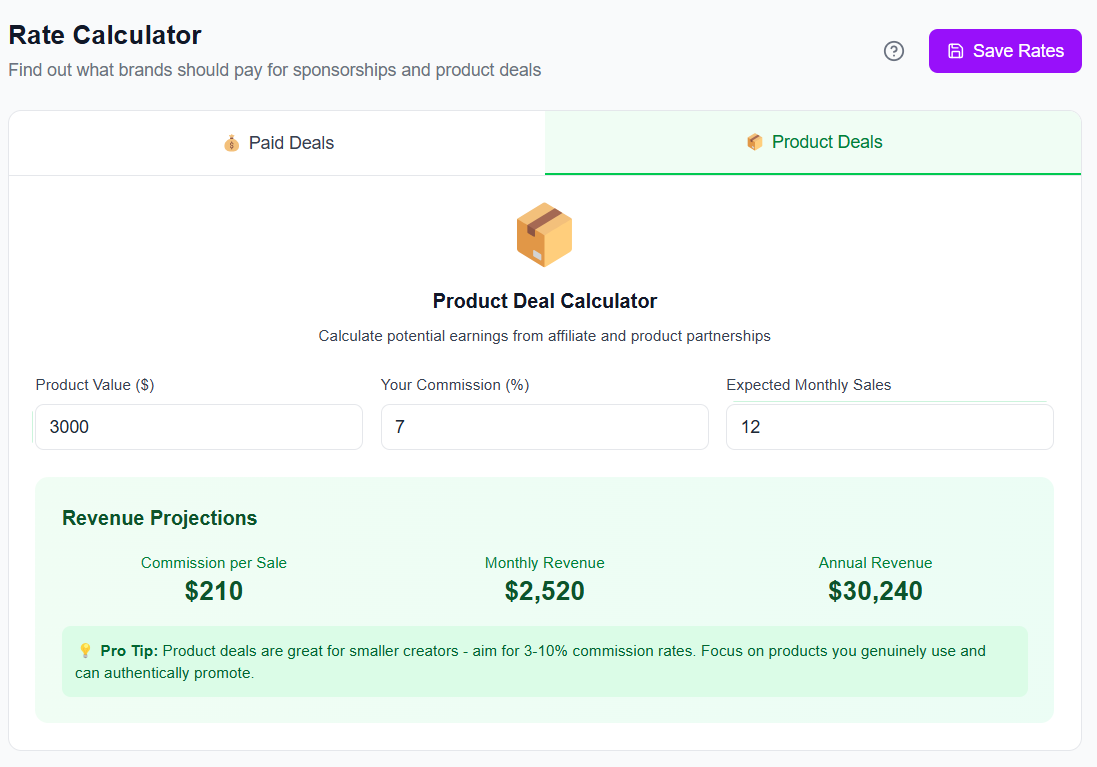
When a brand asks what you charge, open the Rate Calculator and build format-level rates from your size and niche so you stop guessing under market. If products or memberships carry part of the $1,000 target, set up the offer in Creator Store or recurring tiers in Fan Club, then check My Earnings weekly to see which channel actually paid so you double down on the one that is growing.
No universal subscriber minimum equals $1,000 a month. YouTube pay depends on monetization eligibility, views, audience location, niche, and income outside ads. Check YouTube Help for current Partner Program and Shorts rules, then run your own revenue-per-view and deal math.
Yes, if brand deals, digital products, affiliates, or memberships fill the gap. Many creators reach a stable thousand dollars by combining a modest ad check with one sponsor package or a small product catalog. Size helps with reach; trust and offer clarity often matter more for conversion.
Track views, revenue per view or RPM from your analytics, average view duration, brand pitches sent and closed, and product or membership sales. Subscribers are useful for social proof in a media kit, but cash flow comes from the mix you measure and improve every month.
There is no fixed subscriber number that guarantees $1,000 a month on YouTube in 2026.
Run ad income math from your own views and revenue per view; treat any worked figure as an example only.
Brand deals lower the view load required when priced from deliverables and niche fit.
Digital products and memberships create owned income that does not wait on huge sub counts.
A simple three-column plan—ads, deals, products—beats chasing vanity milestones.
Found this helpful? Share it:
iBuildInfluence Team
Creator growth strategist at iBuildInfluence. Helping content creators land brand deals, grow their audience, and build sustainable creator businesses.
Try iBuildInfluenceOctober 24, 2026
September 28, 2026
August 26, 2026
Jump in and use Social Statistics to see what is actually growing.
Open Social Statistics